Livestream Brings an Array of Products to NAB


Livestream logoLivestream has been a leader in Internet broadcasting since the early days of the medium. The company’s continued success has been built on its willingness to respond to customer feedback and evolve with new trends.

Phil Worthington from Livestream had a chat with Don Baine about several of the company’s products. First up was the Broadcaster Mini and Broadcaster Pro. Both of these units are ideal for mobile video producers. At the simplest level, all you’d need to start live streaming is a camera and one of Lifestream’s Broadcasters. Of course, it’s entirely possible to expand from there depending on your needs.

Next up, Phil brought out the new Livestream Studio Surface Go control surface. This compact but rugged control surface is designed to handle all of the crucial functions included in Livestream’s Producer 3.0 production suite. Studio Surface Go is perfect for producers who need a compact but powerful setup for video switching and control.

Phil saved the best for the last with the impressive Livestream Studio HD550. The HD550 is an all-in-one video production system that includes all of the video and audio I/O you’ll need to handle multiple cameras and video sources. It’s also a self-contained switcher and full production suite that works with Livestream Studio 3.0 software. Check the above link for full details. There’s too much to try and list them all here!


Broadcast Pix Roadie is a Powerful Integrated Mobile Switcher at NAB


Broadcast Pix logoIn the world of modern video production, having a powerful switcher is essential. Especially for producers who are dealing with mobile and/or remote situations. Broadcast Pix brought its latest mobile integrated switcher, the Roadie, to NAB to show off its many features.

Don Baine sat down with Lee Griffin from Broadcast Pix. Lee gave more information about the Roadie than I could keep track of! But here are some important points:

  • Integrates with live streaming services like Ustream, Livestream and YouTube live
  • Integrates with social media sites like Twitter, making it easy to interact with an audience in real time
  • Support for HDMI, SDI and IP inputs
  • Support for native Apple and Avid video and graphics codecs
  • Save “virtual sets” for setups that are used frequently, virtual sets can also be easily shared between multiple Roadies
  • Scratch resistant screen
  • Roadie comes with a protective case
  • Weighs 20 pounds for easy portability, may fit into some overhead bins on airlines
  • Uses dual band Wi-Fi for wireless connectivity
  • Can be used with an optional iPad controller app

This barely scratches the surface of the Roadie’s feature set. It’s an incredibly versatile piece of gear and it normally retails for around $12,500.00.


Mike Dell talks Ham Radio and more at NAB


Podcast Help Desk artworkEver wonder what the first true digital medium of communication might be? Most of us probably think of something that involves old modems or maybe some kind of wireless communications system. But the truth is that it goes back much farther than that.

Mike Dell is host of Podcast Help Desk. He’s also a member of the Rawvoice/Blubrry support team. He stopped by Don Baine’s booth to talk about some of his experiences as a new media producer, as well as his love for a truly “old” medium, ham radio.


Brinno Brings Time Lapse Cameras to NAB


Brinno logoThis post kicks off a series of video presentations recorded at this year’s National Association of Broadcasters (NAB) trade show in Las Vegas. These videos showcase new products that may be of interest to professional media producers.

In this clip, Don Baine met up with Chris Adams from Brinno. Chris arrived with three different products to display.

The first is the PeepHole Viewer, or Front Door Security Cam. This camera mounts onto an existing door peephole. It uses a motion sensor to detect when someone’s at the door and it records time lapse video of whoever (or whatever) is there. This device would be great for anyone who wants to know if that parcel was really dropped off when the courier said it was or for anyone who just wants some added security on an exterior door.

Next up, Chris showed off the Brinno TLC200Pro. This is a small but powerful time lapse camera capable of recording short bits of HDR video over extended period of times. It’s optimized to run for months off of one set of AA batteries. The TLC200Pro would be a great way to capture time lapse footage of something like a construction site. The device has an articulating lens and can be used with an optional weatherproof acrylic case so it can be left outside in any environment.

Chris’s final demonstration came in the form of Brinno’s latest version of the TLC200Pro. The new version is smaller and the camera itself is weatherproof, meaning it doesn’t need a case like the TLC200Pro. This new version of time lapse camera works with a smartphone app to set up shots and control the camera. Media recorded by the camera is then sent via Wi-Fi to the smartphone where it can be further transferred and manipulated. Like the TLC200Pro, this camera can run for months at a time on a single charge. This camera would be perfect for anyone who wants to record nature scares over an extended period of time.

The TLC200Plus is expected ro retail for $269.00 while the newer version is expected to sell for $299.00.


USB-C is the new Thunderbolt?


Thunderbolt LogoThunderbolt is seen by many as the latest and greatest protocol for things like high speed data transfer and HD video production. And while Apple has included Thunderbolt inputs on many of its desktop computers for awhile, the technology has been somewhat slow to catch on. Of course, the progression of technology waits for no one, and despite its lack of ubiquity in the wider world, development of newer and faster Thunderbolt technologies has carried on.

This week, Intel announced that Thunderbolt 3, the next version of the Thunderbolt protocol, will use USB-C style connectors instead of the connector types previously found on Thunderbolt cables and devices. USB-C made a splash earlier this year when it was implemented as the lone connection jack on Apple’s new MacBook, eschewing individual ports for USB, power, and audio/video. USB-C works with a “breakout” style cable that has multiple connectors for all of the different protocols typically used by modern computers.

If you’re confused by this development, don’t feel bad. It left me scratching my head, too. The Verge explained it like this (article linked above):

A Thunderbolt 3 cable will look like the current USB-C cables and will support the same power and data transfers, but it will also be capable of much higher throughput (40Gbps) in Thunderbolt mode. The only distinguishing mark? That small lightning logo on the connector itself. This is important because Thunderbolt works by integrating electronics directly into the cable itself — regular USB-C cables obviously won’t be able to carry out transfers at Thunderbolt 3 speeds.

Legacy Thunderbolt and Thunderbolt 2 devices will still work with Thunderbolt 3 thru the use of an adapter. What’s unclear is exactly how computer makers will label ports in the future. Will it be “USB-C/Thunderbolt 3” or just “Thunderbolt 3?” It’s important to recognize that a standard USB-C connection won’t be as fast a Thunderbolt connection and for the most part, USB-C probably won’t even support Thunderbolt devices. Understanding this difference will be crucial for anyone using Thunderbolt devices.

Overall, this change makes sense. After years of dealing with many different types of connectors for cables and peripherals, it could be a real convenience for consumers and manufacturers to have one connection type. But it’s going to be a rocky changeover, especially for those who’d like to keep using older Thunderbolt devices.


GoPro HERO + LCD Camera has Touch Screen Convenience


HERO_LCDsmGoPro has announced the availability of its new HERO + LCD camera. It can capture life-like high definition 1080p60 video and 8MP photos. It also has a convenient touch display that makes it easy for shot framing, settings control, and access to an all new in-camera video trimming feature.

The HERO + LCD is rugged and has housing that is waterproof to 131′ (40 m). Built in Wi-Fi and Bluetooth connect the HERO + LCD to your GoPro App-enabled smartphone or tablet for easy camera control and shot preview when your camera is out of reach. The GoPro App allows for easy content sharing to Instagram, Facebook, Twitter, and more and it combines with the new in-camera video trimming feature to form a convenient content sharing solution.

The HiLight Tagging and in-camera video trimming make it easier to identify and share your favorite moments. HiLight Tagging lets you mark key moments while recording and during playback so you can easily find them later. The all new video trimming feature allows you to create short clips in-camera for easier sharing without a computer.

HERO + LCD will be available for purchase in the United States at authorized GoPro retailers and GoPro.com beginning June 7, 2015. HERO + LCD will sell for $299.99 MSRP. International availability will begin July 12, 2015.

https://youtu.be/IjszDEByTgo


Nvidia Brings Improved 4K to its Flagship Video Processor


Nvidia logo4K video is old news to media professionals. And even tho there have been plenty of products built from the group up with 4K in mind, there are still a lot of legacy manufacturers that need to catch up. Nvidia is a leader in the video processing world. And while they’ve offered some 4K products already, the company believes they still have some improvements to make in how their products handle ultra HD signals.

This week, Nvidia unveiled what is soon to become its next flagship video processor, the GeForce GTX 980 Ti. This new card will deliver better support for 4K resolution, allowing for 45 frames per second, compared to 19fps on the older GTX 680. In heavy graphics intensive situations, Nvidia says its new card can go even higher, all the way to 47fps at 4K on the GTX 980 Ti compared with 18fps on the GTX 680.

This new video processor is powered by Nvidia’s Maxwell microarchitecture, which supports the latest DirectX 12 effects. Video RAM has been upgraded to 6GB of memory compared with the previous card’s 4GB. This new Maxwell chips allow for high-resolution performance and lighting with better frame rates combined with better power efficiency. The GTX 980 requires half the power consumption of Nvidia’s GTX 750, which was powered by the first version of the Maxwell chipset.

The new version of Nvidia’s card will retail for $649 and the introduction of the GTX 980 Ti has also caused the price of the former flagship model, the GTX 980, to drop to $499.


Camlet is the World’s First Multi-Device Camera Mount


CamletSometimes it seems like we really are living in a brave new world when it comes to the many options we have available for mobile media gathering. What used to require a huge rig with tens of thousands of dollars worth of equipment can now be achieved (in many cases) with a mobile phone, tablet and/or a prosumer-grade camera. But there are still challenges when it comes to using these devices efficiently while also making them come together to ultimately create a single entity that’s better than the individual parts.
Many devices have tried to solve this problem in recent years. And the latest entrant to the field is Camlet, an accessory touted as the world’s first multi-device camera mount. Camlet works by pairing a dSLR or mirrorless camera with a mobile device such as a tablet or phone using the Camlet cable and mount system. This “merges” the two devices, allowing for complete control of the camera from the mobile device using either Camlet’s specially designed control app or other apps created by third parties.

Camlet is flexible so it can be used in a variety of different ways. If your camera is on a tripod, Camlet can raise your mobile device up over the top of the camera to make it easier to see. Or if you’re mobile, you can fold Camlet back so the mobile device acts more like a large-screen viewfinder. Camlet can even turn the mobile device around so it’s facing forward, which would be a great solution for vlogging or other times when you need to monitor the video but can’t actually be behind the camera.

Camlet is being launched thru a Kickstarter campaign that’s currently at $41,000 of it’s $45,000 goal. The campaign has just less than three days before it’s over. If you’d like Camlet to be a part of your next camera rig, head over to the link at the top of this article and make a pledge!


IK Multimedia Introduces iKlip Grip


IK Multimedia iKlip GripIK Multimedia introduces iKlip Grip. It is a multifunctional smartphone video stand with Bluetooth shutter control. It is four accessories in one.

The iKlip Grip is a multifunctional video stand with Bluetooth shutter for smartphones, compact video cameras, audio field recorders, and more. It can be used as a desktop tripod, grip handle, monopod or tripod adaptor. It can securely hold any smartphone with a screen size from 3.5” to 6” even when the device is in a protective carrying case.

In addition, iKlip Grip features a standard mounting system for connecting small mobile video cameras like GoPro, compact digital cameras, and stand-mount audio field recorders.

The secret to iKlip Grip lies in its ingeniously secure and expandable holding bracket system. Users can precisely position any smartphone at any angle to capture photos, videos and audio. The iKlip Grip features an expandable spring-loaded soft-touch rubber bracket that provides superior secure holding power.

Repositioning the held smartphone is as simple as expanding the brackets to release the phone, then re-securing it. The iKlip Grip holding bracket features a standard ¼” threaded tripod screw mount so that it can be used with standard tripod as a mobile device adapter.

The base handle of iKlip Grip provides two functions. With its ergonomic hand grip, iKlip Grip fits comfortably into almost any hand to provide a secure and rock-steady way to shoot video on the move on any smartphone, compact video recorder, or field recorder. The base handle is split into three equal sections that can open out to form a secure tripod stand for stationary media capture.

The iKlip Grip also features a pivoting ball-joint attachment system that provides a full 90° range of angle adjustment plus 360° of rotation. The iKlip Grip comes with 17.5”/45cm detachable telescopic extension arm. It gives users an easy way to position their device from 10” to 22” (25 to 55 cm) away – high above the crowd for optimal video and audio recording.


JK Audio’s CellTap 4C is a Compact Solution for Recording Calls


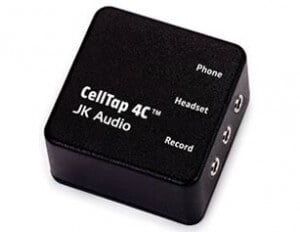
CellTap4CFrom podcast interviews to important personal conversations, there are many reasons why someone might need to record a phone call. But there aren’t many solutions out there that really make the process of call recording simple or practical. Things can be a little easier if you’ve got a bunch of audio gear already, and you just happen to be sitting by it at the time a call happens. But what about those times when you’re mobile or just need a quick call-recording setup? That’s where the new CellTap 4C by JK Audio comes in.

CellTap 4C is an update to its predecessor, simply called CellTap. The new version includes an updated headset jack and a more streamlined design. CellTap 4C has a total of three 3.5mm (mini-plug) connections. Connect the jack marked “Phone” to a cell phone’s headphone jack, connect the “Headset” jack to any headset with a built-in microphone and then connect the “Record” jack to an external device, such as a computer or portable audio recorder. Now, you’ll be able to speak with the caller and record both sides of the phone call (your voice and the caller’s voice) as separate channels on your recording device. (CellTap 4C outputs a stereo signal with each voice panned hard left/right.)

This device could be particularly useful to podcasters who are always looking for new ways to record phone/VoIP interviews. JK Audio was smart in making the output a true two-channel signal, as individual voices can often be unbalanced in single-channel recordings.

CellTap 4C should hit the market this month and is expected to retail for $99.00.