
 Sony Electronics, a worldwide leader in digital imaging, has announced their first POV cameras to feature the innovative Balanced Optical SteadyShot (B.O.SS) image stabilization technology, the FDR-X300R 4K model and HDR-AS300R Full HD model.
The flagship feature of the two new cameras – Balanced Optical SteadyShot – is an advanced form of image stabilization where internally, the camera’s lens and sensor are joined and moved together to compensate for camera shake caused by excessive motion, whether shooting handheld with optional accessories or during a fast-paced sporting activity. This is a particularly effective technology when paired with a POV action camera design as it ensures captured video footage is smooth and stable – even in 4K or high-frame-rate shooting modes.
The versatile FDR-X3000R and HDR-AS300R Action Cam feature a new ZEISS Tessar lens with significantly less lens distortion than previous models. They are also equipped with a new back-illuminated Exmor R CMOS sensor with large pixels designed for 16:9 aspect ratio video plus a powerful BIONZ X processor, ensuring that video quality remains consistently strong across all settings.
FDR-X3000R and HDR-AS300F each have a built-in stereo mic with wind noise reduction to reduce the impact of wind interference on overall audio quality, and are equipped with stereo microphone input for advanced recording.
The FDR-X3000R and HDR-AS300F both include a unique Time-lapse Capture feature that shoots still images in pre-set intervals that can later be transformed into a stunning 4K time-lapse movie utilizing the Action Cam Movie Creator software. The Action Cam App can also create time-lapse movies in Full HD.
The new Sony FDR-X3000R will be sold as body only for about $400 US ($550 CA), and will be offered as a kit (model FDR-X3000R) with the new Live-View Remote for about $550 US ($700 CA).
The new Sony HDR-AS300F will be sold as a body only for about $300 US ($400 CA) and will be offered as a kit (model HDR-AS300F) with the new Live-view Remote for about $450 US ($550 CA).
All products will be available in North America in late September at authorized dealers.
 Video streaming company Livestream recently upped its game in terms of its video-production offerings. Livestream’s portable Studio HD550 and Studio HD51 video production systems are now both



 For years, Firewire was the reigning technology when it came to sending multichannel audio to/from an interface and a computer or other host device. While it’s still technically possible to use Firewire in many instances, the protocol is clearly giving way to other connection types like Thunderbolt and USB 2.0 (and probably down the line, USB 3.0). With that in mind, I was recently in search of a new USB 2.0 mixer. I wanted the ability to send multichannel audio to my computer for recording, and my current mixer, equipped with a USB 1.1 connection, could only send two audio channels. I began searching around for new gear options and was frustrated by just how difficult it was to find mixers and interfaces that met this requirement. After hours of searching and some suggestions I received on a couple of different podcasting-related forums, here’s the list of all USB 2.0 mixers and interfaces I could find that sell for less than $1000US.
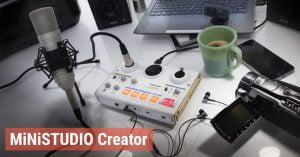 Podcasting has been around for over a decade. During that time, podcasters have had to rely on a plethora of tools that were really designed for other uses. Sure, you can create a podcast with gear that was created for music or live sound production. But it can lead to complex workarounds or other hassles that keep you from the important thing: Creating your podcast. With that in mind, Tascam has released
  Microsoft has endured a lot of criticism lately over its aggressive policy of pushing software updates onto customers. This was probably demonstrated most noticeably over the company’s unwillingness to let users of Windows 7 and Windows 8 stay with their current operating systems, and constantly badgering (and in some cases, forcing) them to upgrade to Windows 10. Now it looks like the Redmond, WA-based tech monolith is about to receive a new round of hate, as its recently released Windows 10 Anniversary Update is